

I don’t want to call myself a Renaissance man because that sounds too self-aggrandizing, but it’s accurate to say I am a man of diverse interests. I pay some measure attention to everything from the stock market1 to bird migration habits2 to trends in sports cards3 to upcoming video games releasing on the Nintendo Switch 24.
Lately, two topics have been recurring in a number of different places I pay attention. These two topics share something, even if they really have nothing to do with each other.
They are data centers and the Los Angeles Dodgers.
The common thread they share is that everyone hates them.
Why?
Because they are totems of realities we cannot control and would not choose and will not stop.
The Data Center Revolt
I don’t know if you’ve heard, but AI is changing the world and if you don’t start using it, you’re going to get left behind. Not in the rapture sorta way, but in some other much more ominous, less cool kind of way, apparently. I use AI for some work functions, and I see some benefit from it. But I remain unconcerned about somehow being “left behind” by it. 5
I’m going to refrain from doing a deep dive into current issues related to AI and the AI revolt here, but I would encourage you to go watch or listen to Ezra Klein’s recent interview with Jasmine Sun, who has done a ton of research and reporting on AI sentiment around the country (and the world).6
Jasmine, speaking about a data center project in Saline, Michigan, outside of Ann Arbor, said this (bolding mine):
…when I learned how the Saline data center saga played out, what happened was the Saline Township board, unlike a lot of boards, actually voted 4 to 1 against rezoning their land for the data center. So this was a case where local government said: This is not our vision for our community. It’s not worth it to us.
And what happened? The data center developers sued Saline Township, a town of, again, a few thousand people, saying: Wait, no, this is exclusionary zoning. You can’t have no industrial use in your entire township. And when a town of that size is getting sued by a giant A.I. data center developer, they just settled.
They were just like: Fine, give us a few million for the fire department and for some schools, and this fight is not worth it to us. But that, to people, felt like a profound violation of little-D democracy.
It felt like the dark money in politics story, which is: You have some very rich companies show up with a bag of money to your politicians. They don’t tell anybody else what’s happening. The politicians aren’t allowed to tell their citizens and involve them in the decision-making process, and they themselves work out a deal — a deal that is fundamentally asymmetric because of the amount of money on one side — that will then transform the image of your community, your lived reality, into the world that these tech companies have decided for you.
And so I think that the data centers, in that sense, are a very visceral microcosm of the way that a lot of people feel that A.I. is showing up in their lives.
Ezra Klein responds to Jasmine, adding:
Sam Altman and all these different people, in front of congressional testimony and in interviews, will say: It should not just be us making these decisions. There should be a real, deep, small-D democratic role here in how A.I. rolls out, in what effects it has on communities and how it is governed.
And then when a community, or a politician who’s representing a community, tries to say: Well, we don’t want this data center here. Or: We want to impose these regulations — we have watched, repeatedly, these companies turn tremendous amounts of financial artillery against whoever is standing in their way. And use the expertise and the money and the power they are amassing to short-circuit that democratic voice.
So here’s the gist. There is a mammoth amount of negative public sentiment around AI right now, even from people like me! I don’t feel good about AI even though I see some utility in it! As Jasmine says later in the interview, one particular aspect of the technology that people don’t like that it is being “shoved down their throats” with no option to refrain from using it.7
Workplaces are mandating its use. Students are being told they can’t use it by teachers and administrators who can’t stop using it or who are even being mandated to use it.
When all of this is happening—all of this cajoling and hypocrisy and political bribery is going on—all around something that makes many uncomfortable on its face, we need a villain.
Whether we like it or not, and most of us don’t: AI is happening to us, and we cannot do anything about it.
It’s like we’re caught out in the middle of a hurricane that people are saying is actually very good for us and might cure cancer, meanwhile all we can see is how it is dismantling the things we care about most.
When we feel helplessly victimized by a force outside of our control, we need a villain. We need something to root against. We need something at which we can direct our disdain. That is what data centers are. Data centers play a key role, of course, in the development of AI. But they are far from the only “problem” with the whole situation. They do make for a great villain, however, because they’re one of the only real tangible, visceral manifestations of this amorphous “AI revolution.”
It’s like I heard on a podcast recently: if these giant data centers had a giant “Netflix” sign on the outside, or something to indicate they are related to a brand people generally feel good about that isn’t AI, there probably wouldn’t be nearly as much backlash, even if all of the environmental and other effects of data centers were still consistent. Paraphrasing Nilay Patel of The Verge in the podcast clip I mention above, people see a data center and immediately see the place where the jobs are going to go away and the cause of electricity’s price increase and the ways Mark Zuckerberg and all these tech guys are going to get even richer.
Data centers are our AI villain, a totem of a forced reality we do not like and cannot evade.
“The Los Angeles Dodgers Are Killing Baseball”
Around the end of July every year, Major League Baseball comes upon their trade deadline. It is a day around the end of July (this year it was August 3) by which all trades must be made within the MLB before the final stretch of the regular season commences.
Every year at the deadline, you have “buyers” and “sellers.” Teams that are well out of the hunt for the playoffs will often offload their star players, especially those whose contracts are about to expire, trading them to teams in the hunt for playoff glory in exchange for young prospects that could be helpful in a few years’ time.
This year, the top player most thought would be available at the deadline was Tarik Skubal, a starting pitcher for the Detroit Tigers and one of the best pitchers in baseball the last few years. The Tigers, thought to be a contender entering this season, have not been as good as projected and are likely out of the playoff picture. Skubal is in the last year of his contract. The Tigers knew the right answer was to trade Skubal to a contender in exchange for prospects and the hope of a better future instead of letting his contract run out at the end of the season and miss getting anything in return.
Fans of any team in contention would have loved for Skubal to join their team. He is an amazing pitcher. But everyone knew as the deadline approached: Skubal is going to go to the Dodgers. Why?
Because the Dodgers have a super team full of future Hall of Famers they acquired by paying for, not developing, and they will pay and do anything to gobble up every best player available.
Tarik Skubal was traded to the Dodgers, and all hell broke loose among Major League Baseball fans, even if they weren’t shocked in the least.
For the record, here are the payrolls of all 30 MLB teams:
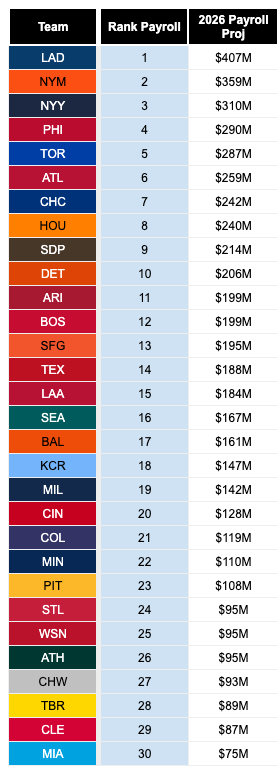
There is no salary cap in baseball, but more on that in a moment.
You can see why baseball fans everywhere hate the Dodgers. Even if they haven’t done anything wrong, they appear to have just bought the best team in baseball. Seems kinda not cool.
They’ve won the last two World Series, because of course they have with that payroll, and there’s every reason to believe they will win again this year.8
But we need to go beyond the Dodgers for a moment—we’ll come back to them in a bit.
Here’s where things get interesting: the collective bargaining agreement between Major League Baseball owners and the Major League Baseball Players’ Association ends this offseason. This is a big deal because of a disagreement between the two parties. To perhaps oversimplify the situation: owners want to institute a salary cap, and the players will not agree to a salary cap.
Owners would like a salary cap for obvious reason(s): so that they can compete without spending $400 million dollars a year or more, which seems to be the requirement at the moment.
Players would prefer not to have a salary cap for an obvious reason: if there is a salary cap, there is a ceiling to how much players can make.
In truth, as a fan, I think we probably need both a salary cap and a salary floor, which is what I believe the NBA has going on over there. We need teams to be required to spend a certain amount on players without spending over a certain amount.
Here’s the deal: there is going to be a lockout/strike in baseball in the upcoming season as a result of the disagreement between owners and players around the matter of player salaries and caps and such. It is possible, if not probable, that the 2027 MLB season will actually just not happen. A number of analysts have all but guaranteed it in the last year or so. 9
Now this is where the Dodgers come into play again.
The problem with the Dodgers is not only that they are just buying up all the good players and buying their way to World Series victories, but it is also that the Dodgers have become the totem, the symbol, the prime example, of why the work stoppage is going to happen.
Whether right or wrong, fair or foul, that is what has happened. They have become the symbol of the problem. Not because they created it, but because they’re the only ones benefitting from it.
Some baseball fans hate the Dodgers because they want to be the Dodgers.
Some baseball fans hate the Dodgers because they are demonstrating everything wrong with baseball right now, even if they’re not doing anything against the rules.
They are exploiting a system that is broken and, in the view of many, exacerbating the issue at hand.
You may recall, I wrote the following above about data centers:
When we feel helplessly victimized by a force outside of our control, we need a villain. We need something to root against. We need something at which we can direct our disdain. That is what data centers are. Data centers play a key role, of course, in the development of AI. But they are far from the only “problem” with the whole situation. They do make for a great villain, however, because they’re one of the only real tangible, visceral manifestations of this amorphous “AI revolution.”
Now let’s replace some key words:
When we feel helplessly victimized by a force outside of our control, we need a villain. We need something to root against. We need something at which we can direct our disdain. That is what the Dodgers are. The Dodgers play a key role, of course, in the broken competitive balance of Major League Baseball. But they are far from the only “problem” with the whole situation. They do make for a great villain, however, because they’re one of the only real tangible, visceral manifestations of this amorphous “competitive balance” problem.
Dodgers and data centers: symbolic, totemic villains of inequalities and cultural changes that are unceasing, out of our control, and unsavory to most people outside of California.
A Final Reflection
Let’s leave baseball behind for a moment, because, while maybe instructive as an image, that issue is of little real concern.
I’m still quite young, at least with regard to workforce demographics. But even more broadly I haven’t quite reached what is commonly called “middle age.” I feel like I’ve seen a lot for a 36-year-old—the internet explosion, 9/11, the Great Recession, COVID, and now AI—but it does lately feel like so much is just happening to us. I’ve been reading pretty widely about young people and their financial nihilism lately, and a sense of powerlessness seems to pervade across wide swaths of American culture today.
We see changes happening that we cannot control and would not choose and will not stop.
Grocery prices are through the roof. Houses are increasingly unaffordable for even middle class Americans. People are gambling at alarming rates because they feel its their only hope of getting ahead. Students are, in some places, being told to not use AI by teachers and administrators who use it freely. Elderly Americans are living in nursing homes that cost so much money that any wealth that may be transferred to their children or grandchildren is going to medicare companies instead. Meanwhile a war with Iran rages on with unclear goals and no real end in sight, exacerbating many of the issues listed above.
All the while we’re collectively standing in the middle of a race course on which a handful of the most powerful, richest companies in the world led by the richest people in the world are sprinting toward a undefined finish line of AI “success,” trampling us as they run, and telling us its good for us, and we better keep up or all hope will be lost.
“What hope?” many say in response.
I am so grateful for my family, my church community, my work, and that I managed to establish a financial foothold in life before all of this started to happen. Because if I was a 22-year-old newly-married college graduate who was struggling to find a job, pay for groceries, and save for a home, I’d be a lot more discouraged by this whole situation than I already am.10
Friends, I think we’re careening toward a cliff, and I think the revolt against data centers is just the canary in the coal mine signaling more to come. It isn’t good when so many people feel powerless. Powerlessness leads to desperation, and desperation leads us to forget the image of God in other people, which leads to violence and all other manners of harm. I am concerned that’s where we’re headed—the mass dehumanization of others to a degree we have not yet seen, at least in my lifetime. And that’s saying something.
The chief promises of AI are increased productivity and efficiency, which eventually provide prosperity. An increasing share of Americans feel desperate for some measure of prosperity that would solve all of their problems, which provides fertile soil for AI’s proliferation. My concern is that humanity, the imago dei, is not optimized for productivity and efficiency. Nor is beauty.
AI is gobbling up every inefficiency in our workplaces, schools, and otherwise.
When will it consume humanity and all of its beautiful inefficiencies?
Are financials the new play with rising interest rates?
Hummingbirds are beginning to arrive in my backyard—has migration begun?
The odds of hitting a solid, numbered logofractor in the new Topps Chrome Baseball Fanatics-exclusive box don’t seem to make it a worthwhile purchase, imo.
I am so excited for Fire Emblem: Fortune’s Weave, but will I be able to finish it before the Ocarina of Time remake releases? Unlikely!
I really appreciated Collin Hansen’s piece at TGC this week about this idea, talking specifically about students and how AI’s acceptable use is wildly variable.
She writes a Substack, which you can subscribe to here.
Except for the fact that they were just swept by the upstart Chicago Cubs (and Boston Red Sox)—maybe the Dodgers needed the help!
If you would like to try your hand at preventing the lockout from happening, check out this new AI-generated, browser video game where you can do just that.
Aside: obviously generalities like this are always dangerous, but permit me to make an observation. I’ve never seen a generational dividing line around an issue more starkly than I do around AI right now. The vast majority of boomers I’ve read on AI or spoken with are maybe a touch skeptical, but generally embrace it. Meanwhile, zoomers LOATHE it. Gen Xers and millennials tend to have more diverse sentiment within their ranks, best as I can tell. But this all makes sense, from one angle. Boomers are in the twilight of their careers and are happy to offload tasks to AI to automate, not very concerned about professional growth and development at this stage. Zoomers, on the other hand, are having trouble finding jobs at all because of AI’s proliferation, so they hate it more readily. This is just a theory, but I figured I’d share.